How an animal with no eyes, no teeth, and no brain became one of the most successful predators on Earth.
A post from the Weekly Jellyfish Blog Series
When we think about predators in the animal kingdom, we usually imagine creatures that rely on raw power, speed, and sharp senses. We picture lions sprinting across the African savanna, sharks patrolling the ocean depths, or crocodiles waiting patiently near riverbanks.
These traditional hunters rely on sharp eyesight to locate their prey, and powerful claws or teeth to overpower it.
But there is another predator in the ocean that hunts in a completely different and arguably more sophisticated way: the jellyfish.
Are Jellyfish Predators?
In the animal world, there are two main feeding groups: herbivores (plant-eaters like sheep and sea cows) and predators (meat-eaters that hunt other animals).
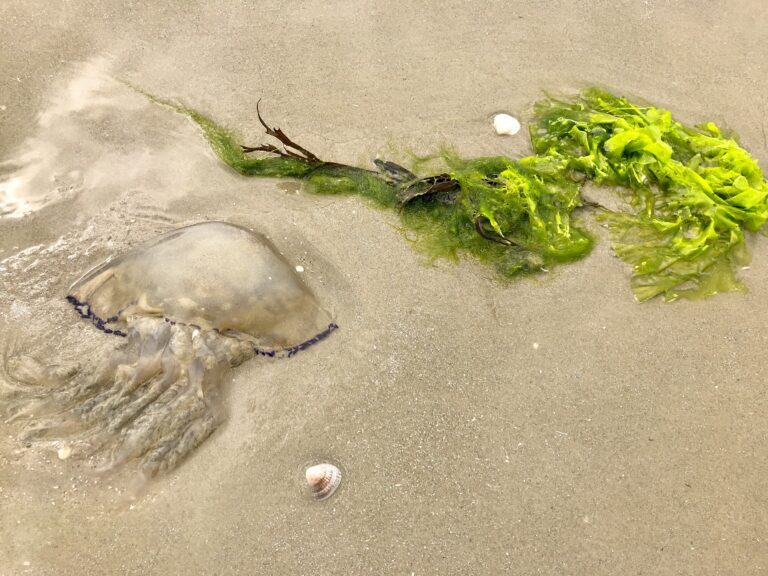
Despite their delicate, floating appearance, jellyfish are absolute predators.
DID YOU KNOW? Most predators rely on vision and speed to catch prey. Jellyfish have neither. They cannot run, they cannot chase after a fish, and they certainly have no teeth to grab it. Yet, they are still highly successful hunters.
So, how does a blind, slow-moving creature catch a fast-swimming fish? Their hunting strategy, which has evolved over hundreds of millions of years, is one of the most unusual and highly effective designs in nature.
The Biological Radar System
Instead of using a single hunting tool like the jaws of a shark, a jellyfish uses millions of tiny hunting units spread along its tentacles. Each one works completely independently, acting as a miniature trap waiting for prey.
As a jellyfish’s tentacles drift quietly in the current, a small fish swimming nearby usually has no idea it is approaching a predator. But the jellyfish knows the fish is there.
On each of these microscopic hunting traps is a set of tiny antennae and sensors a biological detection system. You can think of it as a modern radar system. These tiny detectors sense two things:
- Chemical signals: The natural scent and chemicals released by nearby animals.
- Water movement: The tiny vibrations created by a swimming fish or plankton.
(Don’t want to trigger a jellyfish’s “radar” while you swim? Click here to learn how Safe Sea hides you from their sensors.)
The Trigger and the Harpoon
When the fish gets extremely close, sometimes less than a single millimeter away the physical movement of the water bends the tiny “trigger hairs” on the jellyfish’s tentacle.
That microscopic movement acts like pulling the trigger on a loaded gun.
In a fraction of a millisecond, microscopic harpoons shoot out from the trap, piercing the prey and injecting venom. The harpoons tether the stunned or paralyzed fish to the tentacle, which then slowly pulls the prey toward the jellyfish’s mouth to become its next meal.
A Drifting Fishing Net
What makes this system so remarkable is the sheer range of prey it can capture.
DID YOU KNOW? The exact same hunting system allows a jellyfish to catch microscopic, single-celled organisms (like amoebae), as well as fish that are thousands of times larger, swim faster, and see far better than the jellyfish itself.
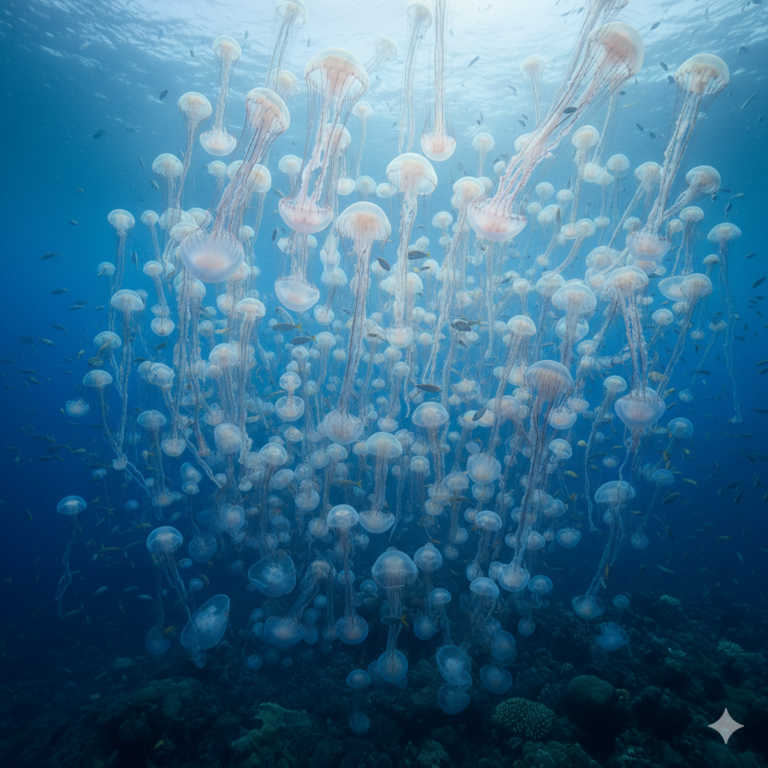
With millions of these tiny traps spread along its tentacles, the jellyfish acts as a silent, invisible, and highly efficient drifting fishing net.
How to Outsmart the Ultimate Hunter
So, how does all this fascinating biology relate to your next beach vacation?
The entire concept behind Safe Sea® is based on understanding exactly how this microscopic hunting system works and then shutting it down.
If a jellyfish relies on chemical signals and physical triggers to recognize prey, we can use science to confuse those sensors. Safe Sea sunscreen contains a patented formula that disrupts the jellyfish’s tiny triggers. When you wear it, the jellyfish’s hunting traps do not recognize you as prey, and the harpoons are never fired.
You don’t need to be faster than a jellyfish to swim safely; you just need to be smarter than its radar.