No eyes. No ears. No brain. So how do they know where they are going?
A post from the Weekly Jellyfish Blog Series
Imagine for a moment that you are sitting inside a dark train carriage, completely sealed from the light, with no windows. The train is moving at a constant speed. Can you tell which direction it’s going?
Now think about a jellyfish. It has no eyes like ours, no ears, and absolutely no brain to process complex information. It exists inside a vast, three-dimensional ocean filled with gentle currents, violent tides, and constant motion.
So how does it know where to swim?
A Small Engine, Big Decisions
Jellyfish swim by contracting their bell a simple rhythmic muscle movement that pushes them forward. But here is the surprising part: studies have shown that jellyfish actually swim faster against the current than when they drift with it. They can distinguish between a steady ocean current and wave motion, and they deliberately swim against the waves.
Why? Because for a jellyfish, the greatest danger in the ocean isn’t a predator, it’s the shore.
Tides and waves can carry them into shallow water, and from there, the path to the beach is short. When this happens, we witness dramatic events: millions of jellyfish stranded and dying along the coastline.
DID YOU KNOW? Even jellyfish washed ashore can still sting. Their microscopic stinging cells remain active long after the jellyfish is stranded, so it is best to never touch them. (Protect your family from accidental stings with Safe Sea Sunscreen).
The Biological GPS: No Brain Required
How does a jellyfish navigate its environment to avoid the shore? Although it lacks a central brain, it possesses a remarkably effective sensory system.
Around the edge of its bell are eight small sensory organs called Rhopalia. Each rhopalium contains tiny crystals (called otoliths, similar to the crystal otoliths we have in human ears) connected to nerve structures. These microscopic organs act as a biological navigation system. They allow the jellyfish to:
- Sense direction and gravity (knowing which way is up or down).
- Detect light and darkness.
- Feel the directional pull of the waves.
DID YOU KNOW? Even without a brain, a jellyfish can process its surroundings and make coordinated “decisions” about where to move to survive.
Steering Without a Wheel
When a jellyfish wants to change direction, it doesn’t turn a steering wheel or flick a fin. Instead, it contracts its bell asymmetrically. A stronger muscle contraction on one side pushes it toward the other. It is simple, highly efficient, and has been working perfectly for over 500 million years.
Jellyfish in Space
This simple but flawless navigation system has fascinated the scientific community for decades.
In a series of highly unusual experiments, NASA actually sent thousands of jellyfish into space to study how the absence of gravity affects their sense of orientation. The goal was to understand how living creatures develop spatial awareness and perhaps discover how human astronauts might better adapt to life in zero gravity!
The “Invisible Belt” – Why Swimmers Need to Know
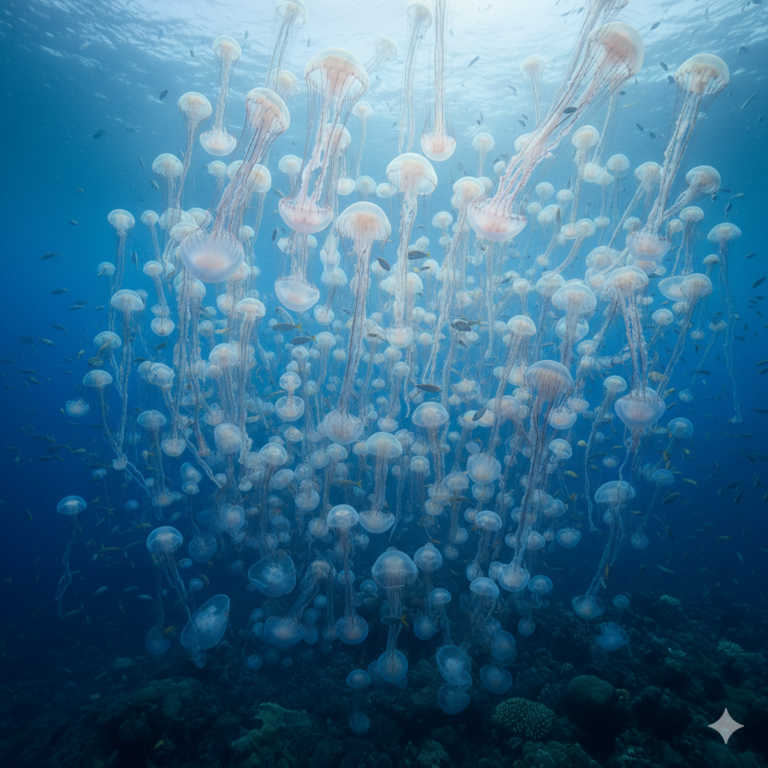
So, where do the jellyfish swim? Very often, they form an invisible “belt” along the coastline, just a short distance from the shore.
This specific zone is the ultimate safe haven for them: it is far enough out to avoid being washed onto the deadly beach, yet rich in the ocean currents that gather the plankton they eat.
The implication for beachgoers is simple: Even if the shoreline appears completely free of jellyfish, just a short distance away right where the water gets deep enough to swim there may already be a massive “wave” of them drifting in the current.
Don’t wait until you feel the sting to realize you’ve swum into a jellyfish belt.
Swimmers, surfers, and snorkelers are advised to apply Safe Sea jellyfish protection sunscreen before entering the water. Our scientifically proven formula acts as an invisible shield, deactivating the stinging mechanisms so you can share the water safely.